
LOWER LEG TRAINER DIPLOMA
A structured, anatomy-based online training for equestrian professionals who want to teach lower leg position with clarity and confidence. Five modules covering knee anatomy, foot and ankle mechanics, bone dynamics, movement sequences, and mounted application.
Lower Leg Trainer Diploma: At a Glance
- On-demand Educator Portal lifetime access
- Trainer Certification on completion
- Trainer License teach TYS clinics professionally
- TYS Trainer Forum community access
- Ball Training Workshop Series, included bonus
Not sure where to start? Book a free 30-minute call with Alysen
About This Training
Over the course of this 3-month online mentorship, you'll delve into our unique core principles - anatomical education, embodied function, and imagery - designed specifically for equestrian trainers.
This program goes beyond theory; it's not just a lecture series or generic movement training. You'll engage in an interactive format, addressing your unique challenges as a trainer and integrating practical solutions that enhance your coaching.
Upon completing this training, you'll gain a fresh, advanced perspective on rider biomechanics and movement, fully equipped with practical tools to immediately apply in your coaching sessions. You'll master mind-body exercises and imagery techniques that can be seamlessly integrated into both ground and mounted work, revolutionizing your lesson plans and delivering the results you've been striving to achieve with your riders.
Discover how to effectively utilize tools like Balls and Bands, alongside scientifically-backed principles, to amplify their benefits in your training sessions.
Join the ranks of our graduates who call this cutting-edge, innovative course the best investment they've made in their professional development as trainers.
REGISTER NOW →
Format
⎯⎯⎯⎯
Online Virtual Training
Training education video portal “Train your Seat Online”
Webinars are interactive and hosted via Zoom

Instructor
⎯⎯⎯⎯
Alysen Starko-Bowes
Founder, Train Your Seat

Next Cohort
⎯⎯⎯⎯
Lower Leg Trainer Diploma Course Schedule 2027
Weekend Intensives, 8 AM to 11 AM MST
- April 3 to 4, Saturday and Sunday
- April 17 to 18, Saturday and Sunday
- May 15 to 16, Saturday and Sunday
Weekly Classes, 11 AM to 1 PM MST
- March 17, Wednesday
- March 23, Tuesday
- April 8, Thursday
- April 13, Tuesday
- April 26, Monday
- May 6, Thursday
- May 13, Thursday
- June 10, Thursday
- June 17, Thursday
- June 24, Thursday

Investment
⎯⎯⎯⎯
$1997
Payment plans available.
One enrollment. A complete professional toolkit.
30+ Hours Live Training
Live Zoom sessions with Alysen, not pre-recorded lectures. Real-time interaction, embodied practice, and direct input as you go. Every session is also recorded.
On-Demand Educator Portal
Every session lives in your personal portal for lifetime access. Return to any module, replay any exercise, build your teaching practice on your own schedule.
100+ Page Trainer Manual
A professionally produced manual covering the anatomy, imagery, and embodied function of the rider's lower leg. A teaching resource you will return to for years.
Individually Assigned Mentor
Your own TYS-certified mentor, a specific person who knows your progress, your goals, and your teaching context throughout the diploma.
Trainer Certification
A formal certificate confirming your completion, shareable with clients, displayable professionally, and usable as verifiable continuing education.
Trainer License + Community
Your license to teach official TYS Lower Leg workshops and clinics professionally. Plus lifetime access to the TYS Trainer Forum.

Ball Training Workshop Series
The hands-on companion to your diploma. Practical exercises using balls and bands to build feel, coordination, and body-awareness, both dismounted and mounted, so the anatomy you learn becomes something your riders can sense and use immediately.
Module Overview
Each module builds a complete, embodied understanding of the rider's lower leg, from foundational anatomy to practical teaching application.
 Module 1
Bone Dynamics & Alignment
Position starts in the bone. How bone structure and alignment govern the movement patterns trainers most often try to correct.
 Module 2
The Knee: 3D Function, Patella & Ligaments
The three-dimensional movement of the knee, the menisci, the patella, and the ligaments behind common grip and bracing patterns.
 Module 3
The Foot & Ankle, Talocrural Joint
The bones, joints, and soft tissue of the foot and ankle, and how they shape the rider's stirrup connection and heel depth.
 Module 4
Muscles, Fascia & Imagery
Muscular and fascial anatomy of the lower leg, tension patterns and habitual holding, with imagery sequences to create felt release.
 Module 5
Teaching Application
How to bring the Lower Leg methodology into your lessons and clinics: assessing riders, sequencing exercises, adapting tools across disciplines.
 + More
More Content Inside
Additional modules and materials are included inside your Educator Portal. Ask about the full curriculum on your discovery call.
Designed for working equestrian coaches, in every discipline
- You are an active trainer, coach, or instructor in any discipline: dressage, jumping, Western, eventing, endurance, or recreational
- You have been giving the same lower leg correction for years and want to understand the root cause
- You hold an existing coaching credential and want a specialist qualification in rider biomechanics
- You are curious about imagery and embodied anatomy as teaching tools, even with no formal background
- You want a structured, mentored learning experience, not a passive video course
- You are a rider who also teaches and want to deepen your understanding of lower leg function
- You are looking for a passive, pre-recorded course with no live interaction or mentorship
- You are a rider seeking personal improvement only, with no interest in applying tools professionally
- You want a short, low-commitment introduction; attend a workshop or book a discovery call first
- You expect change to happen at an intellectual level only; this program requires embodied movement work
What changes in your teaching practice
The correction that never quite lands
You watch your rider's lower leg swing, grip, or creep up, and you give the correction you always give. "Heels down." "Leg still." "Stop gripping with your knee." Your rider tries. For a moment, things look better. Within a few strides, the pattern is back.
You know something is happening in the body you cannot quite name or reach. You feel like you only have half the picture.

You see it differently, and your riders feel it
You know whether the pattern is starting at the ankle, the knee tracking, or a compensation from higher up. You offer the specific image. Their leg drops and settles, not through effort, but because their nervous system has a new map to work from.
Your horse feels the difference: cleaner leg contact, clearer aids, less background noise through the stirrup.
What working coaches say
This course will fundamentally change the way you ride and the way you coach others. The knowledge and the experience of feeling the change in your own body as you apply what you have learned by either working with the simulator yourself of coaching others through the process will set you apart from other trainers in the market. It is worth the investment in both time and money.

I have attended many online courses in different topics. This one with Alysen Starko-Bowes at Train Your Seat Equestrian is really world class. For me, this is much better than going to a course in person. Having the opportunity to re-watch the webinars several times is fantastic. And thanks to all my classmates who shared all their wisdom during the course. Hope to meet you next course!

Practical learning through experience, movement, anatomy and biomechanics has made all the difference for me. Both personally and in working with clients. Results come so much faster!

Train Your Seat connects beautifully to the knowledge I already had, so I can weave it effortlessly into my lessons and even in horse coaching sessions. For me, it’s a great foundation and it gives immediate visible and tangible results.

Frequently asked questions
Is this right for my discipline? I teach Western, jumping, endurance, or dressage.
+Who is this program for?
+Is this program fully online?
+Do I need prior anatomy knowledge to enroll?
+What happens after I complete the diploma?
+Will I keep access to the content after I finish?
+Is the Ball Training really included?
+What can I teach after completing this diploma?
+What if I have questions during the program?
+Is this too theoretical? I need something I can use in lessons from day one.
+The Lower Leg Trainer Diploma

What this investment delivers
This is not a module list you work through alone. It is a structured, mentored, live education built specifically around one area of the rider's body, delivered with 30+ hours of direct time with Alysen, your own assigned mentor, a comprehensive manual, and a commercial Trainer License when you graduate.
Compare this with the cost of a multi-day in-person clinic, with no mentorship, no manual, no certification, and no license to teach. The diploma is a meaningfully different category of professional investment.
Not sure where to start?
Book a free 30-minute discovery call with Alysen. She will help you determine whether the Lower Leg diploma is the right starting point for your goals, your client base, and your timeline. No pressure, no pitch.
Book Your Free Discovery Call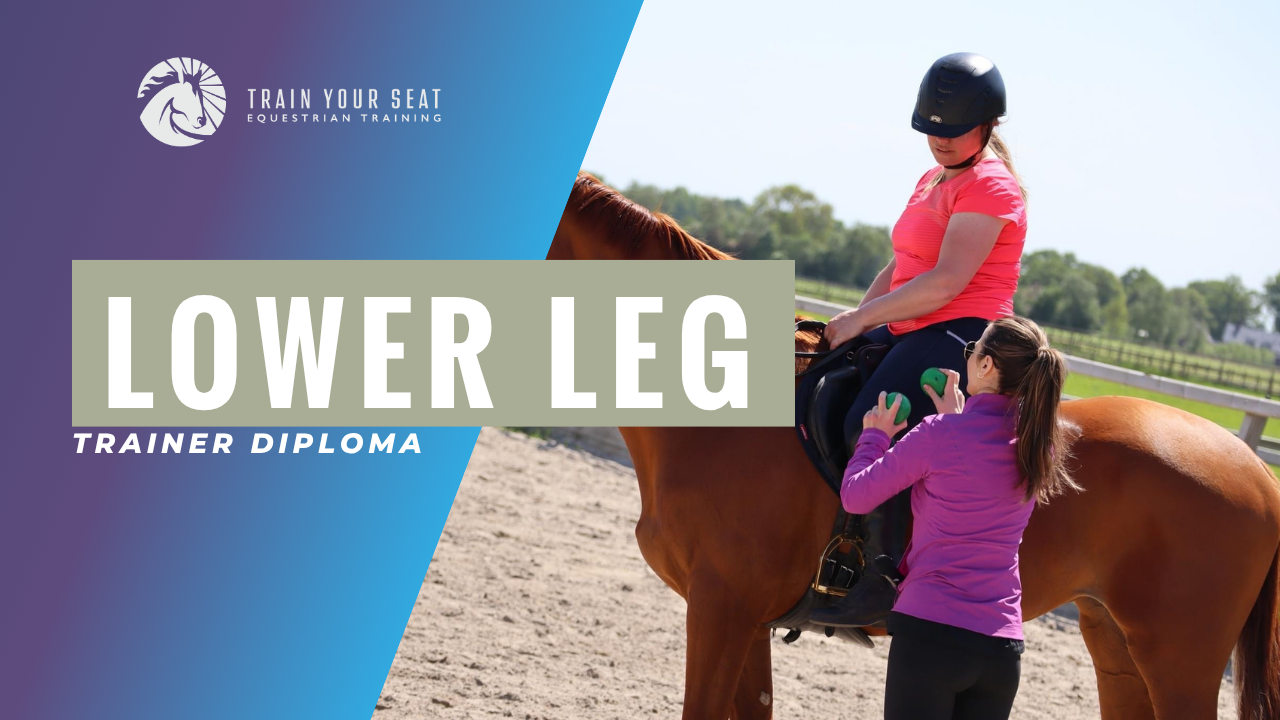
Your riders already know the correction. Now help them feel it.
You already know what to say. This diploma gives you something more powerful: the tools to help your riders actually experience the change, in their body, in their saddle, in a way that holds. And the horses they are riding will feel the difference.

The lower leg is where riders feel most stuck and where trainers feel most limited, and I believe that gap exists because we have been working at the level of instruction when the change needs to happen at the level of felt experience. Your riders' horses are waiting for a cleaner, quieter, more intentional leg. This diploma is how you get there.
Alysen Starko-Bowes Founder, Train Your SeatAPPLY FOR THE IN-PERSON PELVIS TRAINING
To protect the quality of the experience, we review every application. Once you submit your application, you will be redirected to book a call with Aly.
Complete the short form below to get started.